Rock pool safety
Sneaker waves, a rising tide, being cut off, and rock far more slippery than it looks: the four ways a shore actually catches people out, and what to do about each.

Never have your back to the water
This is the whole of it, and everything below is a footnote to it.
Waves do not arrive at a steady size. Swell travels in groups, and every so often a wave runs far further up the rock than the twenty before it did. On the Pacific coast of North America these are called sneaker waves and the National Weather Service issues advisories for them; the same thing happens on every exposed coast under a different name. They are dangerous specifically because the preceding half hour was calm, which is what persuaded somebody to stand where they were standing.
The practical version: face seaward when you are near the edge, and watch the water for a couple of minutes before committing to a low ledge. Never turn your back on it to take a photograph, which is the exact moment most people do.
The water comes back faster than it left
A tide moves slowest at the turn and fastest in the middle of its cycle. That means the shore uncovers gently, lulls you into working further out, and then floods at two or three times the rate you have been unconsciously calibrating against.
Know the time of the low before you set out, and treat it as the moment you start heading back, not the moment you arrive at the far end.
Getting cut off is the one that needs planning
The classic accident is not a fall. It is walking round a headland or out to a rock at low water and finding the way back underwater ninety minutes later.
Before you round anything, look at what is behind you and ask whether it floods. If a route is only passable at low tide, it is a route out and back inside one window, not a loop. Islands and stacks that look walkable are the same problem but with a worse ending, because there is nowhere to go afterwards.
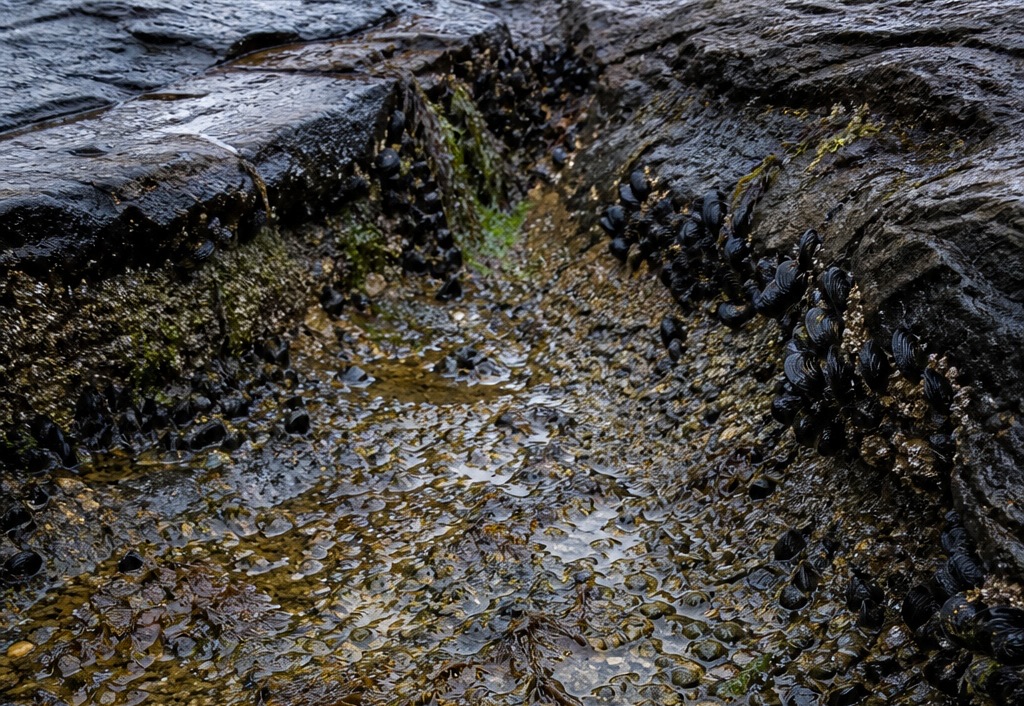
Rock is much slipperier than it looks
Wet rock is fine. Rock with a film of green or brown algae on it is closer to ice, and it does not look any different from three meters away. Most rockpooling injuries are a slip onto barnacles, which cut like a cheese grater.
Grippy closed shoes with a sole you would trust on a wet hillside. Not sandals, not flip flops, not bare feet. Move slowly; there is no version of this where hurrying helps.
Check the swell, not just the tide
A very low tide on a day with a big swell is worse than an ordinary tide on a flat one. The low uncovers the outer ledges, which is the whole appeal, and the swell is exactly what makes those ledges dangerous.
Any surf forecast will give you a swell height and period. Long-period swell, twelve seconds and up, carries much more energy up the rock than a short wind chop of the same height. If the forecast is large, work the upper shore and leave the edge alone.
Cold water, and telling somebody
Water cold enough to be a real hazard does not feel dramatic from the shore. Sudden immersion in water under about 15°C causes an involuntary gasp and a minute or so of uncontrolled breathing, which is what drowns people who could otherwise swim perfectly well. That is a temperature most temperate coasts sit at or below for much of the year.
Tell somebody where you are going and when you will be back. Mobile coverage on a shore under a cliff is often nothing at all, and a headland that blocks the wind blocks the signal too.